Showing posts with label Gonzaga Bulldogs. Show all posts

Monday, March 28, 2016

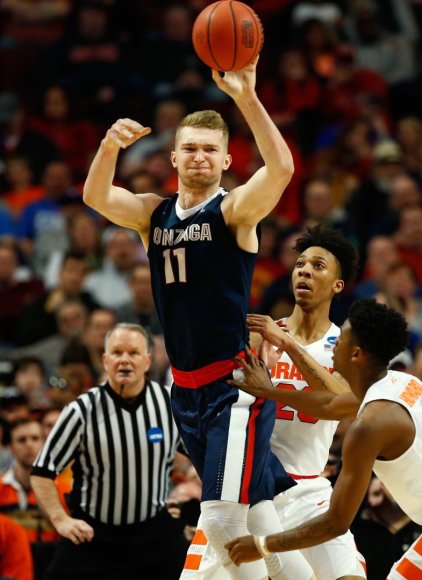
NBA Bound? Why Gonzaga's Domantas Sabonis Should Declare for the Draft

Domantas Sabonis was key to the Zags' success in March and should be a NBA first round pick this upcoming draft.


If you want to understand how the Zags were a minute away from going to the Elite Eight, look no further than the triumvirate of guard Eric McCllelan, forward Kyle Wiltjer and center Domantas Sabonis. In the six games the Zags played in March (in which they went 5-1), the three players all took Ken Pom MVP awards in the games they played, with McCllelan earning three (Utah, St. Mary's and Portland), Sabonis earning two (Seton Hall and Syracuse) and Wiltjer one (BYU). The combination of McCllelan's streaky scoring and tough defense, Wiltjer's offensive versatility and Sabonis' post scoring and rebounding presence made these Zags tough to beat in March, and after Syracuse's upset win over Virginia to earn a spot in the Final Four, it definitely makes you wonder what could have been possible had the Zags took better care of the ball in the closing minutes in Chicago.

While there is no questioning the three's impact in the past month, one of these players will be the sole focus of Gonzaga fans' attention and that is Sabonis. McCllelan and Wiltjer have exhausted their eligibility and will now be transitioning to professional careers in some kind of capacity this summer (Wiltjer could be a second round pick; McCllelan most likely will be looking D-League or overseas). Sabonis on the other hand has just completed his sophomore year, and still has two years left to wear a Gonzaga uniform.

That is if he wants it. Because to be perfectly frank, not only is he a much more sought after NBA prospect than either of the graduating seniors, he also is one of the Zags' best pro prospects in a long time, and has a chance to be the Zags' first First Round pick since Kelly Olynyk in 2013.

Now, make no mistake, Sabonis is not really a bonafide lottery pick by any means and this is a pretty loaded draft (unlike Olynyk's where there wasn't really a consensus no. 1). There is top "one and done talent" in Ben Simmons from LSU (the consensus No. 1), Brandon Ingram from Duke, and Jalen Brown and Ivan Rabb from California. Polished college scorers like Buddy Hield from Oklahoma and Kris Dunn from Providence. And high-upside European prospects like Dragan Bender from Maccabi Tel Aviv and Timothe Luwawu from Mega Leks of the Adriatic League. Without elite height or wingspan, and average to slightly below athleticism, there is no question that Sabonis' pales at first glance in comparison to many of the eligible prospects who are expected to enter this summer's NBA Draft.

Many college coaches would not encourage Sabonis to declare considering his circumstances. To most college coaches, if you're not a lottery pick, the risk is too high and the reward is too great. Famously, Tyler Ennis declared for the NBA Draft though he was guaranteed to be a first round pick, but not a lottery one, much to the chagrin of his head coach Jim Boeheim. Boeheim argued that Ennis would go into a tough situation without much financial security if he was drafted outside the lottery. And, as much as I dislike the whiny Boehiem, he has proven to be right. Ennis has been flip flopped around the league and has probably spent as much time on a D-League floor than a NBA one.

But, Sabonis is a special player, and while his natural gifts and athleticism may not be "first round" worthy, other aspects of his game make him a great value that will not only be seen and recognize by a NBA team, but perhaps even utilized in some kind of playing role as early as next year. Sabonis is not a project by any means, and that alone will give him a lot of value to teams that are looking to build immediately competitive teams through the draft.

So, why should Sabonis leave and not stay for perhaps another "March Run"? Here are two reasons why Sabonis should stay not just for the benefit of himself but to the benefit of the Gonzaga basketball program as well.


Reason No.1: Sabonis' stock is probably as high as it ever will be and there really isn't anything he can truly work on in 2017 to make him a better prospect

I'm not going to pretend to be a "draft" expert by any means. I watch a lot of basketball, college and NBA included (I subscribe to NBA League pass). I will let other, more qualified writers (like here and here) determine Sabonis' exact stock in comparison to other eligible prospects for this draft. But the fact of the matter is this: nobody in college basketball has raised their stock more in the past month than Sabonis.

First off, look at the numbers: Sabonis averaged 17.3 ppg and 11.5 rpg on 61.3 percent shooting from the floor and posted a 76.9 percent free throw percentage in 33 games this year. If you go into the advanced numbers, the Lithuanian looks even better: he posted a 120.0 adjusted offensive rating according to Ken Pom, with a 115.0 adjusted offensive rating against Tier A competition, much better marks than McCllelan (110) and Wiltjer (105). His 28.2 defensive rebounding rate was 14th best in the nation, and his 65.1 true shooting percentage ranked him 21st in the nation. And to wrap it all up, according to Ken Pom's national player of the year ranking, Sabonis ranks eighth, putting him in the same class with other more heralded players such as Perry Ellis (who ranks 5th), Georges Niang (who ranks 6th) and Virginia's Anthony Gill (who actually is behind him at 10th). In a game and professional league that is becoming more and more reliant on analytics and advanced numbers, Sabonis satisfies the requirements as a legitimate first round pick and possible sleeper lottery pick.

But if you're one of those guys who doesn't buy into all the stats (i.e. Seth Davis), then look at what Sabonis has done on the floor. His footwork is impeccable for a post player, and his bevy of fakes and pivot moves makes up for his lack of length and athleticism. Furthermore, his motor is non-stop and without a doubt, Sabonis carried the Zags numerous times this year emotionally, especially in big games such as the WCC Championship and in the NCAA Tournament. But the biggest crowning achievement? His defensive shutdown of lottery pick Jakob Poeltel of Utah in the second round. Poeltel came into the game as one of the best offensive post players in the country, as evidenced by his 17.3 ppg and 8.9 rpg in 34 games and 124.1
adjusted offensive rating for the year. But against Sabonis? The Austrian center was limited to 5 points on 2 of 5 shooting and only nabbed 4 rebounds, good for an offensive rating of 77, his second lowest rating of the year (his lowest was 66 in a contest against Colorado on January 8th). Despite giving up a couple of inches and some considerable weight to Sabonis, the Lithuanian pushed Poeltel off the block on constant occasion and made him a non-factor whenever he was on the floor. If critics needed confirmation that Sabonis could handle himself against NBA bigs, then they were given a rude awakening after his sterling performance against Utah (he also scored 19 points, nabbed 10 rebounds and sported an offensive rating of 134).

And that's the issue with Sabonis coming back. Unless he leads Gonzaga to the Final Four next year, I can't imagine his stock getting any higher. He really has done all he could do to prove that he can play at the NBA level. Furthermore, there is nothing major that he needs to work on that another year of college would help him with. He has played well against good competition in high-pressure moments (the WCC and NCAA Tournament). He has put up good numbers. He has diversified his game, adding a sneaky good mid-range shot. Yes, Sabonis is left-hand dominant, and the athleticism isn't there, but I can't imagine Sabonis really getting considerably better in those categories with another year of college. For some players, coming back made sense. Olynyk needed to get stronger and he could put time in the weight room to do so. Sabonis is already pretty strong and has a NBA frame, and that will get more refined with more round-the-clock training at the professional level. Team-wise, yes, the Zags would be a heck of a lot better with Sabonis. But individually? There really is no incentive for Sabonis to come back, and I think he will realize that and enter the draft with his stock so high already (and could even go up more due to his father being Arvydas Sabonis).


Reason #2: The Zags will be garnering a lot of talent next year, and Sabonis returning could clog things up and result in potential transfers.

While we still do not know Przemek Karnowski's off-season intentions (he probably has more to gain by staying after missing the year due to back injury but you never know), there will be an influx of talent this off-season that will lessen the loss of Sabonis. Center Ryan Edwards, though limited offensively, is a big body that will thrive with more minutes. And furthermore, the Zags will also add Missouri transfer Johnathan Williams, a stretch 4 type who could play small or power forward who has already been practicing with the team (along with Washington transfer Nigel Williams-Goss who could compete with Josh Perkins for the starting point guard spot). But the incoming freshman class will include McDonald's All-American Zach Collins, a 6-11 center from Bishop Gorman in Las Vegas that is the 37th ranked player according to ESPN, and European prospects Killian Tillie, a 6-8 forward from France and Jacob Larsen, a 6-10 F/C from Denmark. Considering the Zags' success with European prospects, it would not be surprising if Tillie and/or Larsen are better than their initial recruiting rankings.

Add all that with Karnowski probably back and somebody's feelings will get hurt on the bench and that could mean a potential transfer at the end of next season. As solid as Mark Few is, he definitely has his issues spreading minutes out, and that has definitely had an impact when it comes to players leaving the program (though for the most part, this hasn't hurt the Zags with the exception of Ryan Spangler, who to be fair transferred more to be closer to home than any beef he had with Gonzaga). Yes, there is considerable risk going with more unproven commodities to fill in Sabonis' spot, but if Karnowski is back it should soften the blow and allow the young guys to grow. Even if Karnwoski is back, the experience returning at guard in Perkins and Melson will also help the post players as they grow accustomed to the college game (though if Karnowski is not back, expect some early losses in the non-conference slate).

Yes, Sabonis would make the Zags a potential Final Four candidate and he would be a Naismith-watch player at the start of the season. But, in this day and age of constant transfers, the Zags would probably be best served if Sabonis declared, and that way, they could determine roles in the post positions this off-season during workouts.


Final thoughts on Sabonis

As a Gonzaga fan, I have to think that Sabonis probably was one of the best frontcourt players in Gonzaga history, up there with Olynyk, Robert Sacre and JP Batista. In fact, I would go out on a limb and say he may be the best post player in Gonzaga history as no other player flashed his combo of efficiency and intensity on a night in and night out basis. Sabonis was fun to watch, especially as he yelled after And 1's and got after refs when he felt he was called. He was a guilty pleasure to watch as a Gonzaga fan, and it is a shame I wasn't able to watch Gonzaga as much as I wanted to this year. If I had followed Gonzaga as closely as I did in years past, I probably would have a poster of Sabonis in my classroom.

But, I love and know the NBA game, and Sabonis is ready and would be a fool to stay. And to be honest, that's okay not just for him, but for the Zags. Sometimes you need to move on, and by moving on, Gonzaga can go into this off-season forming their identity without him with the collection of young, though unproven, talent on the horizon.

As a Gonzaga fan, I know that is scary. After all, this year the Zags were so close to snapping their long-time NCAA Tournament streak, and without Sabonis' the Zags might have been in the NIT losing to Valpo rather than Syracuse. But all good things come to an end, and even though Sabonis leaving would be bittersweet, it is best for both parties involved not just for next year, but the next few as well.

Good luck Domas. I know I'll be enjoying seeing you get after NBA refs on League Pass next year.

Friday, May 30, 2014

Recruit Report: Domantas Sabonis, PF, 6-11, 200 pounds, Gonzaga Commit


Though it's been almost a couple of months since he has signed, no player has been more fascinating this recruiting class than Domantas Sabonis, a power forward prospect from Lithuania. Sabonis comes with all kinds of fanfare already, as he is long, lanky athletic power forward who arrives to Gonzaga with an impressive basketball pedigree. Let's take a look at why Sabonis should be highly anticipated by Zag and WCC fans this upcoming season.


Solid International Experience

Sabonis has been a long-time product of the Lithuanian national basketball program, a major power in the FIBA universe. Remember, this is a country that has recently produced NBA players like Linas Kleiza, Donatas Montiejunas and Jonas Valanciunas. Additionally, as a national program, the Lithuanian team earned the silver medal in the 2013 FIBA EuroBasket tournament, and the bronze medal in the 2010 FIBA World Cup in Turkey. The fact that Sabonis is involved in such a international powerhouse program means that he has had the proper development in his younger years, especially in comparison to other national basketball programs, where coaching and development is a little more uneven.

As for his actual playing experience at the international level, Sabonis has excelled representing Lithuania on the court. He averaged 14.1 points per game 14.4 rebounds per game and 2.6 assists per game for Lithuania in the 2012 U-16 FIBA World Championship (the team finished 11th), and 14 points, 11.4 rebounds and 1.4 assists per game for Lithuania in the 2013 U-18 FIBA World Championship (his rebounding mark was a high for any player in the tournament). In terms of international competition, not only has Sabonis faced some of the world's best young talent, he has displayed he can excel against the top international talent at his age level as well.

But, the international experience doesn't stop there, as like many international talent who end up playing in college in the United States, Sabonis played with a competitive international club last season (you can play for a club as long as you do not sign a professional contract; this is touchy since some try to test how much compensation they can receive, as was the case with Kentucky recruit Enes Kanter, who didn't sign a professional contract, but earned more money playing than allowable by the NCAA and lost his amateur status and didn't play a minute for the Wildcats). Last year, Sabonis played for Unicaja Malaga, one of the top Spanish teams in the ACB league (a league Ricky Rubio also played for before coming to the NBA) that also qualified for the Euroleague (basketball's answer to the Champions League in Soccer). While Sabonis did not play much (he played 10.5 minutes per game in ACB league action and 9.3 minutes in Euroleague play), he was one of the youngest players in the league in general (playing mostly as a 17-year-old) and earned rave reviews from coaches and players for his work ethic and development in his time with Unicaja Malaga. Watch the video below to see some interesting interviews with coaches and players about Sabonis (many interviews are in Spanish, but there are some English ones too).


Furthermore, one of the more endearing traits of international coaching and play is their willingness to "experiment" with young players in terms of positions. Unlike in the United States, where players are primarily placed at a position early on depending on their size and athleticism, Europe is known for having players play at multiple positions regardless of height or size. This has led to taller players displaying skills that is more expected of perimeter players (such as Dirk Nowitzki for example). It sounds like the coaching staff for Unicaja Malaga was willing to try Sabonis out in different positions to improve his development as an overall player, according to this report by Eurohopes, a Euroleague scouting site. Here is a quote from the writer of the report:
"After dominating European Championship U16 as a clear-cut up-front player, Unicaja’s coaching staff has decided to transfer him into tweener, so not surprisingly that in Rome Sabonis is seeing his playing time mostly at SF spot in Unicaja’s packed with sized lineup."

For Gonzaga, this bodes well considering that small forward may be a position of need for the Zags, and they should be in good shape in the post with center Przemek Karnowski returning, and Kentucky transfer power forward Kyle Wiltjer being eligible right away. It is certainly in the realm of possibility that Few could throw out a huge front line with Sabonis at the 3, Wiltjer at 4 and Karnowski at 5. Now, whether or not Few would employ such a lineup on a regular basis is to be determined, but from the report listed above, it seems like Sabonis has worked on playing at the small forward position in his time in Europe, and this should give him a chance to earn minutes and be an impact player immediately for the Zags.


Impressive Basketball Lineage and Skills

Another aspect that should entice Northwest WCC basketball fans is the fact that Sabonis is the son of Arvydas, the legendary Lithuanian player who dominated in his time with the Soviet Union basketball squad and carved out an impressive career with the Portland Trailblazers. While his son Domantas doesn't have the size of Arvydas (Sabonis was a bear literally speaking at 7-3 and 279 pounds) and it is to be determined if he has the overall skill prowess of his father (Arvydas would constantly dazzle fans with his soft shooting touch and excellent passing skills), he does come to the United States at a much younger age (Arvydas was 31 when he came to the NBA).

While some may not agree, basketball pedigree is an important trait that bodes well for player success. Having a father who played at a high level usually results in some of those skills and "instincts" being passed down to the younger generation. The Zags saw this with David Stockton, who while not physically gifted, inherited the excellent passing skills from his father and hall of famer John. Furthermore, the WCC has seen many talented players who came from NBA families carve out good careers at the college level including Luke Sikma of Portland (son of Jack who played for the Sonics), Austin Daye of Gonzaga (son of Darren who played for the Celtics) and Mychel Thompson of Pepperdine (son of Mychal Thompson who played for the Blazers and Lakers). While Sabonis will obviously have the help of the coaching staff to aid his development at Gonzaga in preparation for the next level, having his father's input most likely will also be key in terms of adjusting to life and basketball play in the United States.

But, while having a NBA father has some intrinsic value, it also is a good sign physically as well, as players usually inherit many of the physical gifts of their fathers. That seems to be the case with Sabonis, as he is a tall athletic player and has the same excellent footwork, rebounding skills and tenacity that was characteristic of his father. If you watch the video below, Sabonis finishes especially well at the rim, and is able to display a flurry of post moves and drives that constantly results in easy points. Furthermore, he is able to get rebounds at a good rate, and isn't pushed out easily by opposing players. If there was one quality that was endearing about Arvydas, it was his toughness, strength and tenacity in the paint that complemented his dazzling passing and ballhandling skills. While the strength isn't totally there yet, it seems like Domantas has the motor and the toughness to handle himself at the college level. As he continues to develop muscle strength and fill into his body, it is possible that he could garner the strength down the road as a player that could resemble similarly to his father. Check out the video below and see how Domantas as a 16-year-old held his own and then some in International competition for Lithuania.


What CCH Overall Thinks of Sabonis

There have been a lot of ballyhooed recruits that I have gotten excited about at Gonzaga. Daye came in with an impressive high school pedigree and lofty recruiting rankings. Karnowski was known for his international experience as well as his participation in the Nike Hoop Summit, which in my opinion, is the best high school showcase currently (I think its more competitive than the McDonald's All American Classic or Jordan Brand Classic). Kevin Pangos got on the map for holding his own against future Top-3 pick Andrew Wiggins in Canada. But Sabonis could possibly top all of them in my anticipation of him simply based on his physical skills, international experience and basketball pedigree. I can't remember a player from Gonzaga who had this much development at such a young age, and faced so much elite competition as well before they even set foot in Spokane. Yes, he hasn't gotten the hype that Daye or even current Top-50 recruit Josh Perkins received in the Recruiting media, but Sabonis probably went under the radar because I'm sure many didn't think he was going to college initially. I'm sure many felt that Sabonis would play for Unicaja Malaga for a couple of more years and then make the jump to the NBA like most international players. Instead, Gonzaga gets an interesting player who could potentially have an impact on an even more loaded squad next season.

And I'm not alone in this feeling. Here is what Jeff Borzello of CBS Sports said in a piece that mentioned that Domantas Sabonis will have an impact for the Zags next season:
"One person that watched Sabonis in the past said he would have been a McDonald's All-American had he played in the United States. Sabonis is only 17, but will be relied upon right off the bat for Mark Few and the Bulldogs."

As stated before, it will be interesting to see how Mark Few will utilize Sabonis considering that Karnowski and Wiltjer are more experienced at the college level and will be more established with Few's philosophy in comparison (Karnowski will be in his third year at Gonzaga and Wiltjer had a year in the program after sitting out due to transfer rules). But that being said, Sabonis has tremendous upside and potential, and it wouldn't be surprising to see him making a strong impact and making a name for himself in the college game in his first season with the Zags despite how loaded this Gonzaga team already is.

Sunday, January 5, 2014

Analyzing Gonzaga's Defensive Play Against WCC Foes

Przemek Karnowski (24, white) has helped the Zags be one of the best squads defensively in the WCC


Mark Few has always earned his reputation as an "offensive" coach. Regularly, his teams rank in the top 20-30 in terms of offensive efficiency according to Ken Pom's ratings. He has produced offensively efficient players from the well-known like Adam Morrison and Kelly Olynyk to the lesser-known JP Batista and Kyle Bankhead. This year, the Zags continue to be efficient in the offensive end, as they are rated 10th in the nation with a 117.4 offensive rating this year (which has helped them be rated as the 18th best team in the nation according to KenPom).

But, the Zags wouldn't be sitting alone on top of the WCC now with a 4-0 record if they were just good offensively. Much to its credit, there are a lot of good offensive teams in the WCC this season. St. Mary's has continued their tradition of producing great offense under coach Randy Bennett (though he is sitting out the first 5 games of conference play due to a recruiting violation issue), as they are posting a rating of 116.5, 13th best in the nation. San Francisco and BYU have also been solid squads on the offensive end, as they are posting ratings of 111.0 and 110.4, good for 48th and 57th, respectively. If there's one thing the WCC doesn't lack, it's an ability to score points (only San Diego is not rated in the top-150 in terms of offensive efficiency).

What has separated the Zags in conference play so far has been their defensive performance. Despite missing Gary Bell for three games and Sam Dower battling through injuries, the Zags have posted extremely stellar efficiency numbers on the defensive end so far in WCC play (just accounting WCC games). The Zags lead in six of the nine defensive categories on Ken Pom.com, and in two of them they finish second. They are the top team currently in terms of effective field goal against (39.2 percent), turnovers caused (19.4 percent), offensive rebounds prevented (22.3 percent), 2-point percentage against (35.8 percent), block percentage (18.2 percent) and Adjusted Defensive rating (82.2). To put into context how good their start has been from a numbers standpoint, their Adjusted Defensive rating is 19.7 points better than the second-best team (BYU), their eFG percentage prevented is 5.6 percent better than the next best team (Pepperdine) and their block percentage is 4.7 percent better than the next best team (Portland). The Zags have been absolutely dominating teams on the defensive end so far in conference play, and if you don't necessarily buy into the advanced numbers, you can just look at the scores: against two teams rated in the top-40 in Adjusted Offense (USF and St. Mary's), the Zags held them to a combined 92 points and 0.60 Points Per Possession and 0.80 points per possession, respectively. Additionally, against St. Mary's, the Zags held one of the WCC's best and most efficient players, Brad Waldow to only five points and a season low 48 offensive rating (his previous low this year was 103 against George Mason).

Yes, the Zags' numbers are amazing. However, what makes it more amazing is that they're succeeding in an area where they were supposed to be weak this season. They lost their top-two post players (Kelly Olynyk and Elias Harris) from a year ago, and many pundits (including myself), figured the front court was going to be an issue for the Zags this season. While the scoring and offensive production has been inconsistent, defensively it has been a strength for them. Their 2 point percentage against is 5.1 percent better than the next best squad, and one of the reasons for that has been the defensive play of center Przemek Karnowski.

I tweeted this yesterday after the game:

Karnowski has been a bit inconsistent this year on the offensive side (only a 100.2 Adjusted Offensive rating, compounded by a 48 percent free throw percentage and a 100.0 FT rate; lots of chances and low percentages don't result in efficiency). On the defensive side of the ball though, he has given the Zags a true defensive presence that the Zags haven't had before. At 7-1 and 305 pounds, Karnowski is a load in the post and makes it not only tough for opposing WCC post players to get position on him, but he is effective in taking away driving lanes for WCC guards as well. That was especially evident against USF and St. Mary's as not only did he shut down an elite offensive player (Waldow), but he also provided a wall for the Dons and Gaels to get to the hoop, leading to the sub-par performances each team experienced in Spokane.

Additionally, the subtraction of Olynyk and Harris, while devastating on the offensive end has actually been good on the defensive end, as Karnowski may be a better post presence defensively than either of them, especially Olynyk (who was the true center last year). Numbers wise Karnowski bests Olynyk in terms of block percentage (8.6 to Olynyk's 5.1) and defensive rebounding percentage (24.2 to Olynyk's 20.5). But even on the tape, Karnowski shows excellent instincts for a post man, as he knows what to do well and understands how to use his body as a wall to protect the hoop, even if he may not be the most athletic big man in the WCC. One of the problems for Olynyk was that he would get out of position at times on the defensive end, which would not only hurt in terms of allowing points at the rim, but also make the Zags vulnerable to allowing second chance shots. That hasn't been the case with Karnowski this year. He stays his ground well and is able to do just enough to get in the kind of defensive position to take away easy shots in the paint (something you couldn't always say out Olynyk). And, to make things better, Karnowski doesn't sacrifice rebounding position to defend shots, and this has been a reason why the Zags have been much better at preventing offensive rebounds this year than a season ago (32.2 percent offensive rebounds prevented rate, third best in the WCC).

That being said, Karnowski is not alone in terms of helping the defensive effectiveness of this Zags squad. With the Polish center taking away the middle with his solid frame, strong defensive instincts and ability to limit second chances shots (he has a team high 24.2 defensive rebounding percentage, 63rd in the nation), his presence has complemented the Zags' perimeter defenders nicely. The biggest surprise contributor has been 6-5 wing man Kyle Draginis who has seen an uptick in playing time since Bell's injury. Draginis has the length and speed to frustrate opposing guard, and it has been obvious that the defense has improved since he has earned more minutes in the absence of Bell. Furthermore, his 2.5 steal percentage has been a nice surprise for a team that leads the WCC in turnovers caused percentage. Of course, Draginis has not been the sole reason for their superb play on the perimeter defensively. David Stockton, though out matched at times physically, continues to be a pesky defensive player, as he is second on the team in steal rate at 3.3 percent. Gerard Coleman, who was buried for a while on the bench until he earned more minutes with Bell's injury, leads the team in steal percentage (3.6 percent) and has the kind of wing span that belies his size (6-4) and makes him a matchup problem at times for opposing guards. And Angel Nunez may be the biggest wild card of all, as he has the size and length to guard smaller forwards on the perimeter or small post players in the paint (though strength-wise, that is still a question). The bottom line? The Zags have all kinds of weapons on the perimeter, and the presence of Karnowski and a healthy Dower down low make those wing players able to be more aggressive on the defensive end, knowing they have that presence in the paint taking away the drive at the basket.

At the end of the 2006 season, it seemed like Few was at a crossroads in terms of what to emphasize defensively as a coach. Though he has produced good defensive squads his first years, in 2005, they ranked as the 4th best team in the WCC in terms of defensive efficiency and they rated as the third-best team in the WCC in 2006. The reason? He had excellent offensive players in Adam Morrison and JP Batista and it seemed that the Zags went into contests with the idea that they could simply outscore and provide just another defense to win. There was some success with this model, as they did reach the Sweet 16 in 2006 and lost to a team that eventually went to the NCAA Championship in 2006 (UCLA). Instead though of preferring that style, he has recruited more defensively talented and inclined players since the Morrison-Batista era (they haven't ranked below second in defensive rating in the WCC since 2006) and that is still relevant today, even with the WCC offensively probably at its most talented in comparison to years past. The Zags are not just able to scrap by defensively, but they have showed that they are able to dominate squads (and good offensive squads) in the WCC. In a conference where there is much more parity than in years past, the Zags emphasis and ability on defense this year may be the chief reason why they rise above the pack for another consecutive season.

Saturday, January 4, 2014

Recruit Report: Josh Perkins, 6-3, 185 pounds, Gonzaga commit


One of the highest profile recruits coming into the WCC next year is Gonzaga commit Josh Perkins out of Huntington Prep High School in Huntington, West Va. If the name of the school sounds familiar it should be, as former high profile recruits Andrew Wiggins and OJ Mayo played high school ball there during their senior seasons (Huntington has effectively become the next Oak Hill Academy, which was famous for getting senior transfers from all over the nation; the list include Carmelo Anthony, Josh Smith and DeSagna Diop to name a few). Originally from the Denver, Colorado-area, Perkins looks to be the kind of player that could continue Gonzaga's great tradition of producing effective guards.

ESPN currently rates Perkins as the 38th best recruit in the nation according to their Top-100, and also considered UCLA and Minnesota before signing with the Zags. Even though Kevin Pangos and Gary Bell are most likely going to return for the senior seasons, Perkins looks like he could be a good sixth man off the bench next year for the Zags as a guard, especially with longtime and popular point guard David Stockton graduating this year.


What they are saying about Perkins

From Rivals.com (graded him a four-star recruit and 46th best in the nation)

"A very flashy playmaker from Colorado who sees open teammates pretty much anywhere on the floor. Whips passes with either hand and makes plays in transition. On offense he favors pull-up jumpers and sometimes settles. Opponents who can really move laterally can bother him."

From Scout.com (graded him a four-star recruit and the fifth-best point guard in the nation)

"More than anything, Perkins is a sensational passer. He makes the difficult ones look easy and can make the easy ones difficult, but his abilities in this regard are indisputable. Perkins also is a talented scorer. He doesn't draw as much praise for that for that ability and understandably so, but he knocks down three-pointers on the high side of screens and shoots well setting himself up off the dribble." 

From Slipper Still Fits (Gonzaga SB Nation Blog)

"Perkins is undoubtedly one of the highest rated recruits to ever commit to Gonzaga.  He had offers from outstanding programs across the country, most notably UCLA, Minnesota, Connecticut, Arizona, and Stanford.  He received significant interest from Kentucky, Syracuse, and Kansas as well.  He is currently a top-30 prospect on both Scout and Rivals which is similar to where Austin Daye was rated and slightly higher than where Matt Bouldin checked in at when he arrived at Gonzaga."


Catholic Coast Hoops Quick Analysis

When you watch Perkins on tape, he is just a phenomenal passer. He simply has an uncanny ability to find the open man with extraordinary quickness and accuracy. If anything, he reminds me a lot of a taller Sebastian Telfair with his ability to handle the ball, drive and find his teammates with ease (and I do NOT use that comparison frugally; I watched Jonathan Hock's "Through the Fire" like a dozen times). While I do not have stats on his current shooting stats, scouts rate him as a solid shooter, and his form looks good on tape, as he is able to pull up and shoot the jumper quickly when his team is in transition. Scout.com also raved about his 3-point shooting, rating it as one of his strengths as a player along with his passing and court vision.

The Slipper Still Fits, which has been following him in person for a good while (one of the main writers of the blog lived in Denver and used to see him when he was still going to high school in Denver), remarked he was one of the highest profile recruits since Austin Daye (Daye was one of the first truly "High Profile National Recruits" the Zags signed, though some argue Jeremy Pargo holds that honor since he was a pretty highly rated recruit of Chicago). I sort of agree with the assessment, though I think Kevin Pangos and Przemek Karnowski would have been rated higher had they been "American" recruits (both guys played for the international squad in the Nike Hoops Summit their senior years, which is just slightly below the McDonald's All American Classic in terms of prestige). Nonetheless, Perkins is a legitimate recruit, and much like Daye back in 2007, I believe Perkins will be making plenty of buzz when he arrives on campus next Fall (or technically Summer, since most basketball recruits come to take classes in the summer to get a head start). Because of Pangos and Bell's presence next year, I don't think Perkins will break out as a star or have the kind of immediate impact those two had when they arrived. That being said, I think he'll be a key factor in the Zags' rotation his rookie campaign and earn a sizable chunk of playing time that will develop him to have his true breakout in his sophomore season.

Tuesday, December 31, 2013

Why Kevin Pangos May Be the Greatest Guard in Recent Gonzaga History


Awww...memories


First off, I am a Gonzaga alum. My dad wasn't a Gonzaga alum, but he went to Gonzaga for his first three years of undergrad (he finished at USF, where my grandfather went, so USF always feels like a second-favorite team to me). I lived in Spokane for six years when I was little. So, maybe I am biased toward Gonzaga in some small subtle ways when evaluating WCC teams (though I have gotten better at respecting the WCC as a whole over the past few years; hence the creation of this blog). However, if there is one thing I know, it's Gonzaga basketball history. I remember a day when John Rillie and Kyle Dixon were the starting backcourt for the Zags (Yes, Rillie and Dixon. I'm sure a lot of WCC basketball fans just sports referenced those two).  I'm not just a recent fan of Gonzaga who started liking the Zags because of the Adam Morrison days or if you're real hardcore, the Dan Dickau days. I've seen Gonzaga when they've been great and I've seen them when they were fair-to-middling (I don't remember the days when they outright sucked, which is always exaggerated in my mind; Gonzaga wasn't Gonzaga back then, but people who say the sucked grossly overstate it; they were more like Portland is now). I've seen games when they used to sport the Royal Blue and Red (wish they'd go back) and I remember when they had a coach who used to get so fired up that he made Mark Few look like an altar boy in comparison (Dan Fitzgerald, RIP, who unfortunately was pushed out acrimoniously due to a funding issue when he was AD).

So, when I say guard Kevin Pangos may be one of the greatest guards, perhaps even the greatest in Gonzaga recent history, I am not shooting this from the hip. This isn't a knee jerk reaction. I loved Blake Stepp and Derek Raivio. But Pangos may be better than either of them, and this year, statistically he is proving it. He not only could be the reason the Zags win the crown in a suddenly wide-open WCC, but he could be the reason why they stay competitive on the national college basketball scene.

First off, I am only going to compare Pangos to guards who played at Gonzaga from 2003 on. It's the furthest Ken Pom stats go back. I wish I could go back further, but I don't have the time, stats or resources to compare guys like Dickau or John Stockton or Matt Santangelo to Pangos (on a knee jerk suspicion, I say Pangos is definitely better than Santangelo, maybe same level as Dickau and slightly worse Stockton; Stockton really didn't become legendary until he went to the NBA, though he was pretty good at Gonzaga). One of the projects I hope to do is do some historical statistical analysis on some classic WCC teams. I don't have the time now, but that is something that could happen in the summer, which would make comparisons or posts like these all the more interesting and valuable.

Now, if you have not noticed, statistically, Pangos is having a season that is teetering on legendary when it comes to offensive efficiency. His Adjusted offense according to Ken Pom is 139.2, which is top in the WCC for anyone with at least a 20 percent usage rate. While Gary Bell is close to him at 138.1, Bell's rating benefits from his extraordinary shooting touch (as he has displayed all three seasons at Gonzaga). But, Bell doesn't touch Pangos in terms of creating plays for his teammates as well as taking care of the ball. The difference between Bell's assist and turnover rate is +4.4. Pangos? +12.2, highlighted by a 20.7 assist rate. This isn't a fluke either, as Pangos' difference last year was +2.9 while Bell's was -3.6.

What makes Pangos so great is how he has developed his game since coming to Gonzaga. In high school, Pangos earned a lofty reputation for his ability to shoot from the outside, carry a rather thin team talent-wise and go toe-to-toe with future phenom Andrew Wiggins. If you watch this video, Pangos scored at will against Wiggins' Vaughn team when Wiggins was a frosh. You can see Wiggins eventually switch to guard Pangos after Pangos starts lighting up the Vaughn squad. But even though Wiggins had obvious physical advantages over the smaller guard, Pangos was still able to make Wiggins and Vaughn pay en route to a game high 48 points.

Pangos has showed a similar ability to drop an obscene amount of points at times. He scored 34 points against Arkansas in the Maui Classic this year, and obliterated a Washington State Cougars team with 27 points as well. But, his game has evolved and that what makes the possibility of Pangos being legendarily great in the Gonzaga lore possible. He has lowered his turnover rate to under 10 percent this year after past rates of 15.7 and 16.5 his sophomore and freshman seasons, respectively. His effective field goal percentage has risen to 60.5 after being 54.9 percent a year ago. He is getting to the line more than a year ago (33.3 free throw rate in comparison to the 26.2 rate last year). And he is doing this with  more minutes than in years past (his 85.2 minutes percentage is a career high so far), and a higher usage rate (21.0 usage rate this year). Some players, who get the uptick in usage and minutes struggle to keep the same efficiency they had when they had the ball less in their hands and when they were on the floor less. Not only has Pangos maintained the same efficiency, but he has actually gotten better, which they needed from him after they lost go-to guy Kelly Olynyk from a year ago.

But when you compare what he's doing in the lore go Gonzaga history, what Pangos is doing is amazing. Yes, Pangos and Bell could possibly make the best guard-combo Zags fans have ever seen, but what Pangos is doing by himself is pretty darn special. Blake Stepp's best season in adjusted offense came in 2003-2004, where he posted a rating of 117.1. Derek Raivio's best season was 122.7 in 2006-2007, but he only posted positive assist to turnover rates only twice in his career (and in his 2006-2007 season, the difference was only +.5). Jeremy Pargo never posted a turnover rate less than 20 percent and consequently his best season efficiency-wise was his senior year when he had a rating of 107.1 (better than his WCC Player of the Year junior season actually). Matt Bouldin's best year came his junior year when he posted a 119.1 offensive rating, but he also struggled with turnovers over the course of his college career, and he actually regressed in his senior year (his rating fell to 115 his last year). And Steven Gray? After a sophomore campaign when he posted a 120.1 offensive rating, he struggled with more minutes, as he failed to post offensive ratings over 109 in his junior and senior campaigns.

As you can see, there are a lot of names up there, and a lot of quality guards who have had immense impact and success in their tenures with the Zags. And yet, neither of them can touch Pangos' 139.2 offensive rating, and very few have showed the upward progress Pangos has made from his freshman year to his current state. Pangos came in more as a shooter and he has developed more into an overall player that can step up when needed. He has been overshadowed the past couple of years by upperclassmen and bigger stars, but now that Pangos is asked to shine, he has lived up to the hype and then some. If the Zags want to make the tournament, win another WCC title and perhaps make a run deep in the tourney, then they are going to have to lean on Pangos to make it happen, especially with Sam Dower and Bell's health an issue at this point.

And you know what? It most likely will happen, because Pangos has been that good this year and stepped up his game that much. Despite the flaws and question marks of this Gonzaga team, Pangos has continued to keep this Gonzaga team humming and currently cemented in its familiar place in the WCC: the top.

Monday, December 23, 2013

Were Gonzaga and St. Mary's Exposed After Weekend Losses?

Even with the addition of BYU and Pacific, the WCC race within the past decade has come between Gonzaga and St. Mary's. Mark Few and Randy Bennett have been the staples of coaching success in the WCC, and on a regular basis the two schools have produced their fair share of talent (Adam Morrison, Austin Daye, Kelly Olynyk, Omar Samhan, Patty Mills, Matthew Dellavedova just to name a few) which has resulted in a slew of victories and NCAA Tournament appearances for both programs.

That being said, both teams came into this season with a lot of question marks. The Zags lost mainstay forward Elias Harris and glue guys Mike Hart and Guy Landry Edi to graduation, and saw Olynyk leave a year early (can't really blame him) to become a first round draft pick by the Boston Celtics. As for the Gaels, not only did they lose all-conference stud Dellavedova, but they also lost big man Mitchell Young to graduation. While both teams returned a lot of key pieces from their successful 2012-2013 squads, they also lost some key players whose productions would have to be replaced in order to replicate last year's successes and be competitive not just in the WCC, but at the national level again in 2013-2014.

How have the results been so far? So far good for both squads. Entering Saturday's game, the Zags came to Wichita with a 10-1 record to face a talented, but inconsistent Kansas State squad. As for the Gaels, they were away for the holidays, traveling to Hawaii to take on South Carolina, another inconsistent squad that was coming off head scratching losses to Manhattan and USC Upstate in consecutive games, in the first round of the Diamond Head Classic (another interesting subplot was if the Gaels took care of business, they could have faced Boises State, who are coached by former Gonzaga assistant Leon Rice).

Contribute it to the travel or Christmas break or whatever, but things did not go as well as planned for both squads. The Zags struggled against an athletic and scrappy Wildcats team, and without the services of big man Sam Dower, who went down in the first half with a hip injury, the Zags' lack of size was greatly exposed on both ends of the court. As for the Gaels, they were unable to stop the hot-shooting Gamecocks defensively, and they ended up getting surprised by a team that looked to be a bottom feeder for the second straight year in the SEC.

Is this a cause for concern for Gonzaga and St. Mary's fans? Or is this another case of the "Christmas break letdown" blues? (This has been the case for Gonzaga a lot in the past decade). Let's take a deeper look into both games:


Gonzaga versus Kansas State (72-64)

For the year, Kansas State has struggled to find offensive consistency for the year. Their adjusted offensive rating according to Ken Pomeroy is 102.2 (roughly 1.02 points per possession), and their effective field goal percentage is 46 percent, 283rd best in the nation. Their inability to find consistent offense explains why they have some letdown losses to teams like Northern Colorado (at home) and Charlotte (neutral court). However, if you want to give credit to second-year coach Bruce Weber (and I don't like to give him credit for anything the way he drove that Illinois program into the ground), you have to applaud his ability to keep the Wildcats solid as a defensive squad. This year, their 94.3 adjusted defensive rating is 20th best in the nation, and they excel in terms of contesting and forcing bad shots and turnovers, as they are holding teams this year to a 45.1 effective field goal percentage (44th best in the nation) and have a turnovers forced percentage of 21.9 (27th best in the nation). The big story was this: could the sweet-shooting Zags succeed against a K State team that held teams in check on the perimeter and from beyond the arc (the Wildcats are holding teams to a 25.8 percent three point percentage for the year, 4th best in the nation)?

Well, Kansas State succeeded on the defensive end for the most part. Sans the performance of Kevin Pangos (more on him later), Drew Barnham and the limited performance of Sam Dower before he went out with injury, the Zags were immensely poor on the offensive end. While Karnowski shot well from the field (5-of-6), his 0-for-6 performance from the charity stripe hurt the Zags as he finished with an offensive rating of 92 for the game, according to Ken Pom. David Stockton and Kyle Draginis also provide mediocre performances on the offensive end, as they finished with offensive ratings of 92 and 90, respectively. But the worst offender of the game? Gary Bell, who has showed some strong consistency this year in his junior season, posted a rating of 64, as he struggled from beyond the arc, missing some key three point shots down the stretch and finishing 1-of-7 from the field with a mere 3 points. The Zags for the game finished with only 1.03 points per possession, greatly down from their 1.16 season average (which went down from that game, so it was higher but I don't have the number yet). Kansas State needed to shut down the Zags on the offensive end to have a shot in this game, and when Dower went down, the Zags's lack of size (minus-2.0 effective height for the year, 299th in the nation, and that is WITH Dower) and presence in the post was greatly exposed and the Wildcats were able to put more pressure on the perimeter with only Karnowski as the legitimate threat in the paint.

However, another story for the game was the Wildcats' offensive breakout. Kansas State averaged 1.20 points per possession in this game, helped by 52.8 percent shooting on their two point shots (though they continued to struggle from beyond the arc, as they only made 5 out of 18). Furthermore, they were able to out rebound the Zags on the offensive end (10-8 on the offensive glass), get to the free throw line more as well (25 to the Zags' 15), and they turned the ball over less than the Zags (4-to-12). Considering the Zags lost all four factors of this game, the fact that they only lost by eight is pretty remarkable. Forward Thomas Gipson proved to be the thorn for the Zags individually, as he scored 14 points on 6 of 8 shooting, good for an offensive rating of 163 in only 21 minutes.

So, should Zags fans hit the panic button yet? Well, it all depends on the health of Dower. X-Rays have come back negative on Dower's hip, but it'll be interesting to see how he recovers and how this will affect his play for the year. While the Zags have transfer forward Angel Nunez eligible, he did not play in the Wildcats game, and it'll be interesting to see if he'll get an increased role with Dower's health a question over the coming weeks. That being said, I think this was the perfect storm game for the Zags, as the loss of Dower, combined with the rare offensive outburst of the Wildcats put the chips stacked against the Zags from the beginning. As I said before, the fact that they only lost by eight, despite losing all four factors of the game is pretty remarkable. I will say this: Pangos is certainly the backbone of this team, and I think it's his "WCC Player of the Year" award to lose this year. Despite getting shut out in the first half, Pangos made the necessary adjustments in the second half and finished with 14 points, 6 assists and an offensive rating of 120. Pangos is proving he's "The Man" on this Gonzaga team, and I think the confidence he got from this game will bode well for the Zags going forward, since they aren't going to face a lot of teams that are as big a threat defensively as the Wildcats in WCC play.


St. Mary's vs. South Carolina (78-71)

The big issue with Randy Bennett's squads in the past is that they have played soft non-conference schedules. This year has been no different, as the Gaels have only played one game away from home (Boise State) and have not played anyone in the Top-50 according to Ken Pom's ratings. So, while the 9-0 record was nice, many wondered how the Gaels would stack up against the Zags in conference play, since their record was padded by such an easy early schedule.

I expected a letdown of some sort from the Gaels in this tournament, but I did not expect it to come at the hands of South Carolina, a team that was coming off brutal losses to Manhattan and USC Upstate (rated 84th and 154th, respectively by Ken Pom). However, the Gaels, while again efficient on the offensive end (12th in the nation in offensive efficiency), have displayed inconsistency this year on the defensive end, as evidenced by their 101.1 defensive rating, 128th in the nation. The Gaels don't cause a lot of turnovers (only an 18 percent turnover rate, 208th in the nation) and they don't get a lot of steals (7.9 steal rate, 252nd in the nation), so they rely on their presence and ability to force bad shots in order to be effective on the defensive side of the ball. It has worked for the most part, as teams are only shooting an effective field goal percentage of 47.1, so when the Gaels are able to settle down defensively in the half court, they do show some ability on the defensive end to prevent points on possessions.

However, for whatever reason, the Gamecocks came lighting it up in Hawaii, as they shot 58.5 percent on their two points shots, and four of seven from beyond the arc. The offensive performance was a surprise for the Gamecocks, as they were shooting a woefully bad 44.9 on their two points shots this year, and post an overall effective field goal percentage of 46.5. And yet, the Gamecocks were able to shot almost 14 percent higher than their season average on two point shots, which lead to them scoring 1.24 points per possession against the Gaels. Surprisingly, the Gaels didn't slouch on the offensive end, as they averaged 1.13 points per possession thanks to the performances of Stephen Holt, Beau Levesque and James Walker, who posted offensive ratings of 137, 124 and 142, respectively. Waldow also scored a team-high 20 points, though his 112 offensive rating and 28 percent possession percentage made his performance less impressive to the other three.

So where did the Gaels go wrong? While the Gamecocks did get to the line more, they didn't make it count, as evidenced by their 62.1 percentage from the charity stripe. One of the big factors had to be on the offensive glass, as even though the Gamecocks had less for the game, they had a higher percentage of offensive rebounds (44 percent) to the Gaels (38.2 percent). Add that with a superior shooting day for the Gamecocks, and the Gaels, despite playing effectively on the offensive end, just weren't able to pull this one off. Guards Sindarious Thornwell and Duane Notice had effective games against the Gaels' perimeter players, as they scored 13 and 11 points, respectively (good for ratings of 129 and 183). Additionally, they got excellent production off the bench from 6-11 big man Laimonas Chatkevicius (12 points 7 rebounds, 119 rating) and guard Brenton Williams, who hit two key threes in the game. This was a stark contrast to the Gaels, as they got limited production from their bench in this game, as only guard Kerry Carter had much of an impact as a reserve, and even he struggled to get going in this game (91 rating, 5 points).

Much like Kansas State against the Zags, the Gamecocks outplayed their usual output on the offensive end, and that proved to be the Gaels' undoing, especially since they are not a team that generates a lot of turnovers on the defensive end (they depend more on shutting down opponents and limiting second chance shots). The Gaels are not a very deep team, as they only got 12 minutes this game from their other bench players other than Carter (who had 36), and their bench only has accounted for 24 percent of game minutes for the year, 322nd in the nation. This will be interesting to see come WCC play, for the Gaels could be in trouble if key players get into foul trouble (which they have avoided for the most part this year). One through Five, the Gaels can play with anyone, and their ability on the offensive end is for real as well. But the perimeter depth (though certainly not front court depth) of Gonzaga could pose problems for the Gaels when they face each other in WCC play. That being said, I still believe the Gaels are legitimate contenders in the WCC, even despite the soft non-conference schedule and loss to South Carolina on Sunday.